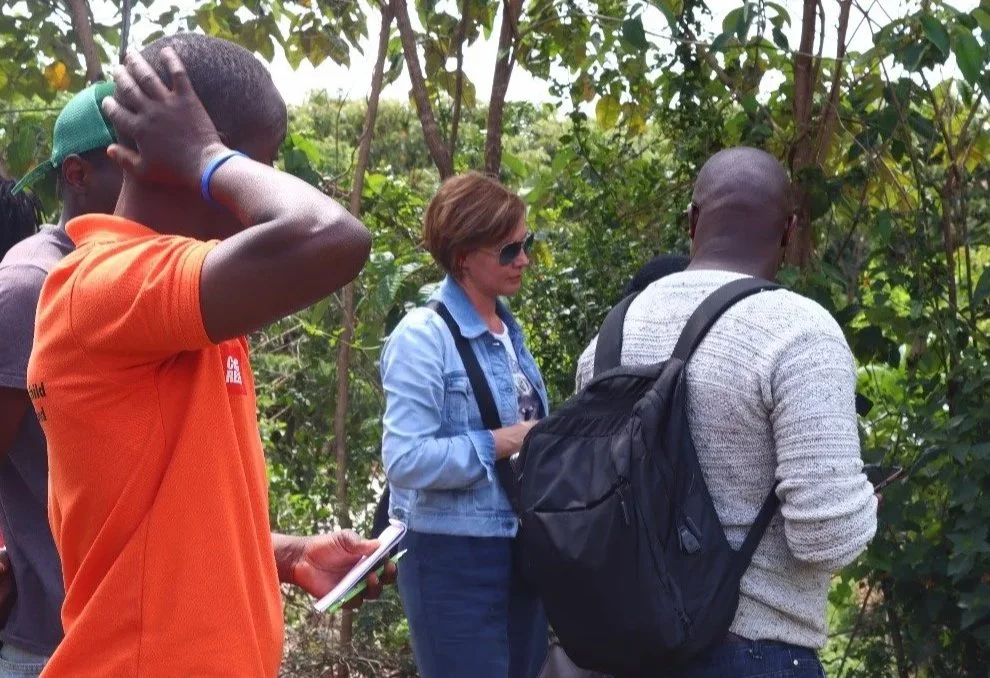
November 2024, Nairobi, Kenya | Me, visiting the Tempo Art community to learn about the regeneration of land and the effects on the community (picture credit: Nicole Bastien)
Meeting Reality
Somewhere, right now, someone is deciding what happens to a piece of land they will never visit again. A permit granted for a mine a few time zones away. A supply contract renewed without asking where the water comes from. A landfill sited on the edge of a township because that's the parcel nobody with influence lives near.
Most of these decisions are made by people who consider themselves careful and considerate. But the decisions are made in meetings, with spreadsheets, behind closed doors, away from where the decision touches ground.
Through What Matters, I work in townships in South Africa alongside small businesses building income out of leather, bread, water, or cloth. I wasn't looking for evidence of a regenerative economy. And yet I ended up finding more of it than I expected. Not more proof of a regenerative economy, but people with no choice but to live inside the results of their own decisions.
Sister Batanana works with leather using indigenous methods that have almost disappeared. She could produce differently. Industrial chemicals would probably make parts of the process faster. Her decision is not primarily about preserving tradition. It is about something much more immediate. She works with her hands. Everything she uses eventually touches her own skin. What enters the leather also enters her body. She cannot separate the way she earns her living from the conditions that allow her to remain healthy.
Papa Peace farms nearby. He knows that exhausting the soil eventually exhausts his own livelihood. Using more pesticides may solve today's problem while creating another tomorrow. Nobody taught him a principle about regeneration. He simply has nowhere to put the consequence of exhausting his own soil. The consequences of his decision come back to him, the way weather does.
Neither Sister Batanana nor Papa Peace would call this an economic philosophy, or virtue, or regenerative economy. Actually, they don’t care about the words. But I care, and I would call it proximity. That's what I found, watching them. And that means people who remain close to the consequences of their economic decisions organize those decisions differently from people who can outsource them somewhere else. Wealth, wherever it accumulates, buys the option of not seeing. The landfill goes wherever the people with decision power don't have to smell it.
My own work builds on the principles of regenerative economy, and I still find myself uneasy with how the term regeneration gets used and often misused. Reached for as the next framework to implement, the next thing to roll out. What I want to follow instead is narrower.
Humanity is the purpose. Regeneration, I've come to think, is what happens when we are close enough to what we cause that looking away is no longer an option. Perhaps regenerative economy begins with remaining in relationship with the consequences of our decisions.
What Is an Economy?
We use the word economy constantly. Governments talk about strengthening the economy. Businesses contribute to the economy. Newspapers report on the economy every day. Yet we rarely stop to ask what we are actually referring to.
Our answers usually come quickly: markets, trade, businesses, jobs, money, GDP. Production and consumption. None of these answers is wrong. None of them feels sufficient.
The moment you leave the financial pages and spend time where people are simply trying to make a living, no matter where in the world, the economy looks much larger than the categories we usually use to describe it.
A grandmother looking after her grandchildren so their parents can work. Neighbours repairing each other's roofs after a storm. Someone sharing seeds with another farmer after a failed harvest. Volunteers organizing meals for families who need them. Parents teaching children skills they will carry throughout their lives. None of these activities appears in our economic statistics. Remove them, and much of what we call the economy would quietly stop functioning.
We have become accustomed to recognizing only those parts of the economy that pass through markets. Not because they are more important, but because they are easier to count.
Economies existed long before accounting systems. Long before GDP, stock exchanges, or corporations. People still had to eat. Build shelter. Raise children. Care for one another. Resolve conflict. Exchange knowledge. Organize work. Prepare for winter. Share risk. An economy begins there; not with money or markets, but with people continuously organizing the conditions that allow life to continue.
An economy is not first a financial system. It is a social practice. Money, markets, businesses, and governments all participate in that practice. But none of them is the practice itself.
A Structural Fact
If an economy is a social practice, what makes that practice regenerative?
My first instinct was to look for the visible architecture: businesses, investment models, policies. Eventually I understood I was looking in the wrong direction. Regeneration isn't a structure we can point to or a framework we implement.
Sister Batanana and Papa Peace didn't arrive at their practice by choosing it. There was nowhere else for the consequence of their choices to go. What she puts into the leather touches her own skin. What he takes from the soil, he takes from his own next season. They simply never had the option of distance so that the consequences of their decisions could travel elsewhere.
So, the practice is not a set of better values, then. It looks more like a structural fact about how far a decision has to travel before it comes back to the person who made it.
Which means regeneration isn't a condition some people have and others lack. What I learned from my fieldwork is that regeneration happens whenever a system makes it impossible to outsource what we cause. And distance is what happens whenever a system makes that outsourcing available to anyone, anywhere, who can afford it.
This reframes the question I actually want to ask for the rest of this essay. Not: what makes that practice regenerative? But: what would it take to build economic mechanisms (money, investment, policy) that don't let the distance open up in the first place? Mechanisms that make distance structurally impossible. To find an answer, we don't start with what to build. We start with what to close.
The Shape Distance Takes
Money is the first mechanism worth testing against that standard, because money is where distance isn't just possible; it's the whole design.
We measure money, calculate its returns, speak of access to capital as though money were capital's only form. It's an understandable habit. Money is visible, it moves, it can be counted. But healthy soil is capital too. Clean water is capital. Trust, knowledge, skill, time, health, … all of it is capital. A thriving business depends on people who can work together. A farm depends on living soil. Financial capital doesn't replace these. It depends on them.
What money's design does that these other forms of capital cannot: it travels. A coin doesn't remember the mine. A wire transfer doesn't carry the smell of the landfill. That is not a flaw. The design works exactly as intended. Money is the one form of capital built to separate cleanly from its own consequences, which is also what makes distance affordable at any scale.
Investment is where that design gets used on purpose. We invest in businesses, their founders, technology, a company with potential. But no business begins in isolation. Every one depends on conditions that already existed: educated people, trusted institutions, roads, ecosystems. Parents invest in children. Teachers invest in capability. Neighborhood organizations invest in belonging. None of it is called investment. Most of it isn't counted as contribution to the economy at all.
Silicon Valley comes to my mind. It gets told as a venture capital story. But the venture capital arrived after decades of investment in conditions. Universities, public research, infrastructure, and a culture with tolerance for failure were there before VCs arrived. The companies weren't the beginning. They were the visible consequence of investment nobody photographs. What would happen if we became as interested in cultivating and deliberately investing in conditions as we are in financing what rises out of them? This is not a rhetorical question. Investment, understood this way, isn't about financing a single actor. It's about deciding what future we're close enough to shape.
Government runs the same test at the scale of a population. Underneath regulation, infrastructure, and redistribution lies the sharper question of what conditions no individual or business can create alone. Justice. Public health. Reliable institutions. These aren't products government delivers. They're conditions everyone depends on, and no one owns individually. Which makes government the actor with the most structural power to decide how far a decision gets to travel from its consequence. Most policy responds only once a problem is visible. Unemployment rises, a subsidy follows. Necessary, and still symptom-work. The harder question is: what conditions are we building before the problem becomes unavoidable, and do they keep decision and consequence close, or let them drift?
Underneath all three sits place. We speak of national economies, global economies, as though the economy exists somewhere above the people living inside it. I have never met a national economy. I have met neighborhoods, townships where a business survives because a relationship survives. This is where an economy becomes real. But also where development aid has most consistently gotten it backwards, designed elsewhere and delivered in, measured against indicators set far from the lives they're meant to improve. Every community already holds knowledge, relationships, history. None start from nothing. The question was never how to bring an economy to a community. It's how to strengthen what's already standing there. At least how we approach it with our Community Economy Development.
Money, investment, policy, place aren't independent things. They're connected mechanisms, so that distance isn't something we defeat once. If we close it in money (say, currency that can't separate from where it came from) but leave investment untouched, the same distance we closed in one place just shows up in the other. The gap between decision and consequence doesn't get smaller. It relocates.
Coming Back
Sister Batanana didn't choose proximity. Neither did Papa Peace. What they have is what's left when a decision has nowhere to travel to, when there is no distance available that lets the consequence land somewhere else.
Most of us reading this have that distance available, by default, without asking for it. Capital that moves. Mobility. A degree, a passport, an office three time zones from the mine, the landfill, the harvest. Nobody has to build that distance for us. It's already built into how money moves, how investment finances what's visible, how policy responds only once damage has surfaced. We don't choose to use it. We simply don't notice that we are.
Which means regeneration means something different for us than it does for Sister Batanana. For her, it isn't a virtue. It's what's left when there's no distance to retreat into. For us, it can only ever be a decision made against a distance that was already available. Staying close on purpose, when moving the consequence elsewhere would have cost nothing and no one would have known.
I think that's why I keep going back to the townships, as I affectionately call them „our people“: the farmers, the leather artists, the spaza owners, the water engineers. Instead of writing about them from somewhere else. Not because the field depends on me there. Because that is exactly the distance I would be experiencing if I didn't go. And for what I am bringing in this world, I need proximity for better strategic decisions.
Humanity has to be the purpose of our work. Regeneration is what happens when someone with the distance available chooses not to take it.
The question worth carrying past this essay isn't whether we believe in a regenerative economy. It's simpler, and it has to be asked again at every decision, not just once: How far is this decision made from the person who will live its consequence?
Get the conversation going and leave your comments to the reflecton my LinkedIn profile.
Visit us🤩
our What Matters activities www.humanitywhatmatters.com
our CO-LAB as lead organization www.humanityeconomy.com